Posted in News, UncategorizedTagged , , , , , , , , , , , ,

AI Can Help Start a Fleet Graphics Concept, it Takes Human Creative Expertise to Make It Road-Ready.

AI is quickly becoming part of the creative process for many companies. From early logo ideas to full vehicle mockups, more brands are experimenting with AI-generated visuals to explore what their fleet graphics could look like.

And in many ways, that makes sense. AI can be fast. It can help teams visualize ideas. It can give internal stakeholders something to react to before a formal design process begins. For companies in the early stages of a brand refresh, fleet rollout, or new vehicle graphics program, AI can be a useful starting point.

But when it comes to fleet graphics, a starting point is not the same as a finished design.

Vehicle graphics have to do more than look good on a screen. They need to work across real vehicles, real materials, real installation conditions, and real-world visibility. That is where human design expertise, production knowledge, and fleet graphics experience become essential.

At Signature Graphics, we understand that AI-generated concepts are becoming part of the conversation. Our role is to help customers understand what those concepts can do, where their limitations are, and how our team can move an idea from inspiration to a powerful, production-ready fleet graphics program.

AI is most helpful when it is treated as a brainstorming tool.

For companies that are still trying to define the look and feel of a fleet program, AI can help generate visual directions quickly. It can give teams a way to compare styles, explore color palettes, test general design themes, or gather feedback from internal decision-makers.

Maybe your team is trying to decide whether the fleet should feel bold and modern, clean and corporate, energetic and colorful, or more traditional. AI-generated concepts can help bring those early conversations to life.

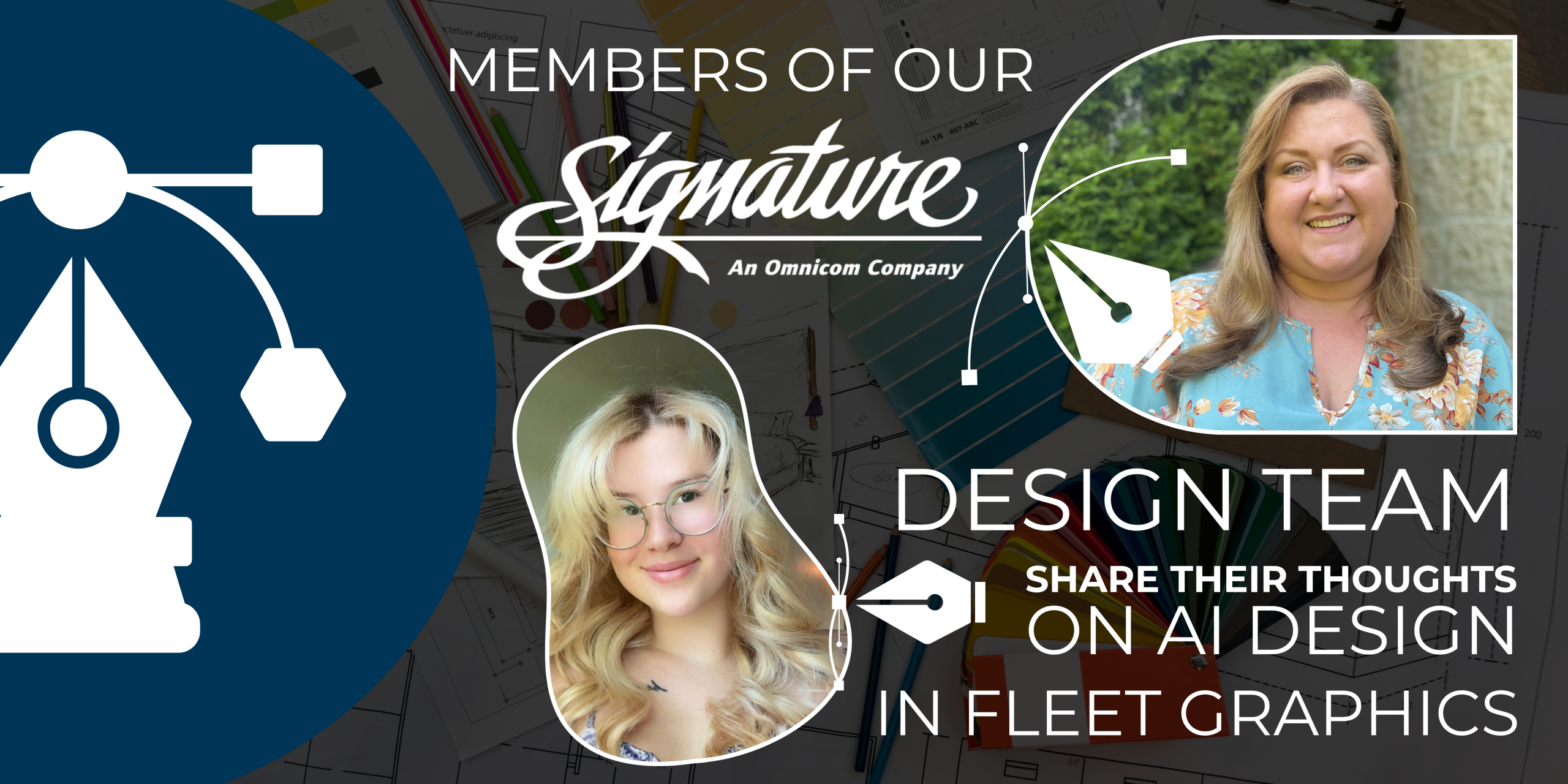
Carrie, Creative Director of National Accounts and just shy of 30 years as a graphic designer at Signature Graphics, explains that AI concepts can help reveal a customer’s general preferences early in the process.

“What is often useful from AI generated concepts is the basic likes/dislikes for a client. AI can come up with concepts so quickly, it would give a designer a better target at hitting rather than throwing something on the wall and trying to make it stick.”
Carrie Flores | Signature Graphics

Kenzie, a Graphic Designer at Signature Graphics, also sees AI as something that can have a place in the earliest stages of idea development, as long as it is not treated as the final answer. She recommends using it “in the early stages to gather ideas,” but also emphasizes the importance of taking that starting point and shaping it into something original and brand-specific.

In other words, AI can help a customer say, “We like this direction,” or “This feels too busy,” or “This is closer to what we had in mind.” That kind of feedback is valuable. It gives the design team a better understanding of the customer’s taste, goals, and expectations.

But it is only the beginning.

An AI concept is not usually ready to print

One of the most important expectations to set is that an AI-generated vehicle concept is typically not a production-ready file.

A fleet graphics design needs to be built with production in mind. It must account for the specific vehicle make, model, body style, measurements, curves, doors, windows, handles, hinges, seams, fuel doors, placards, and installation requirements.

Most AI-generated images are flattened visuals. They may look like a finished design, but they usually do not include the layered artwork, vector elements, brand assets, measurements, or production files needed to manufacture graphics at vehicle scale.

Carrie explains the issue clearly.

“At this point, resolution of AI generated concepts is not good enough for printing as large as vehicles require,” Carrie said. “In addition, when AI generates a concept, it does so on the vehicle, not giving us actual production files, so there is no real way to remove the artwork from the vehicle because AI gives a flattened JPEG version.”

Kenzie sees this challenge often in the design process. When customers bring in an AI-generated concept, the visual may communicate a general idea, but the artwork itself usually has to be rebuilt or reinterpreted before it can become something Signature can produce.

“It is never ready to print,” Kenzie said.

That may sound direct, but the reason is practical. Fleet graphics are produced at a much larger scale than a digital image or small-format print. If the image is low resolution, flattened, or built on an unrealistic vehicle mockup, it cannot simply be enlarged and installed without losing quality or accuracy.

This does not mean the AI concept has no value. It means the concept should be understood as inspiration, not final artwork.

Fleet design is different from designing a digital ad, brochure, or social media graphic. A vehicle is not a flat rectangle. It is a three-dimensional surface with physical interruptions and installation variables.

A design that looks impressive in an AI-generated image may not work on the actual vehicle.

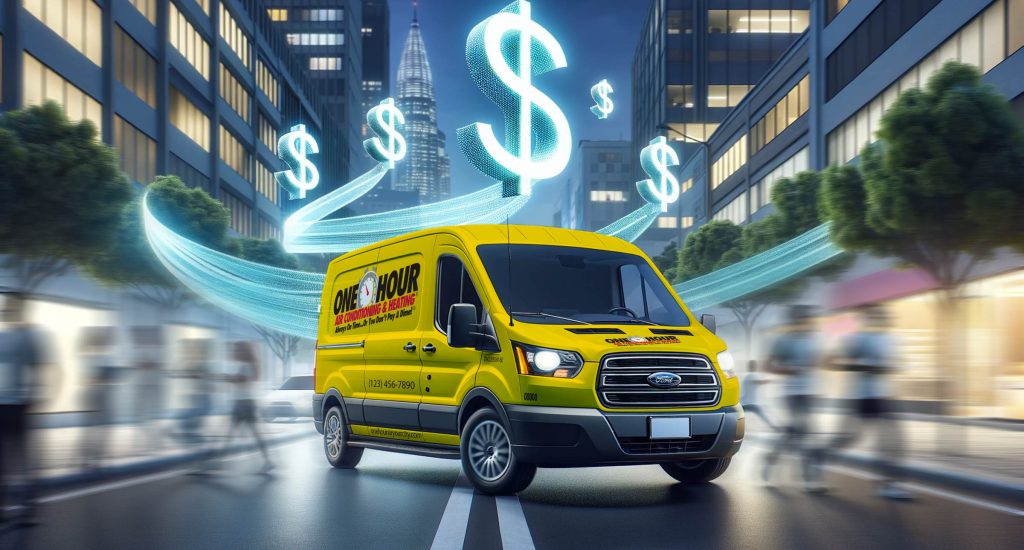
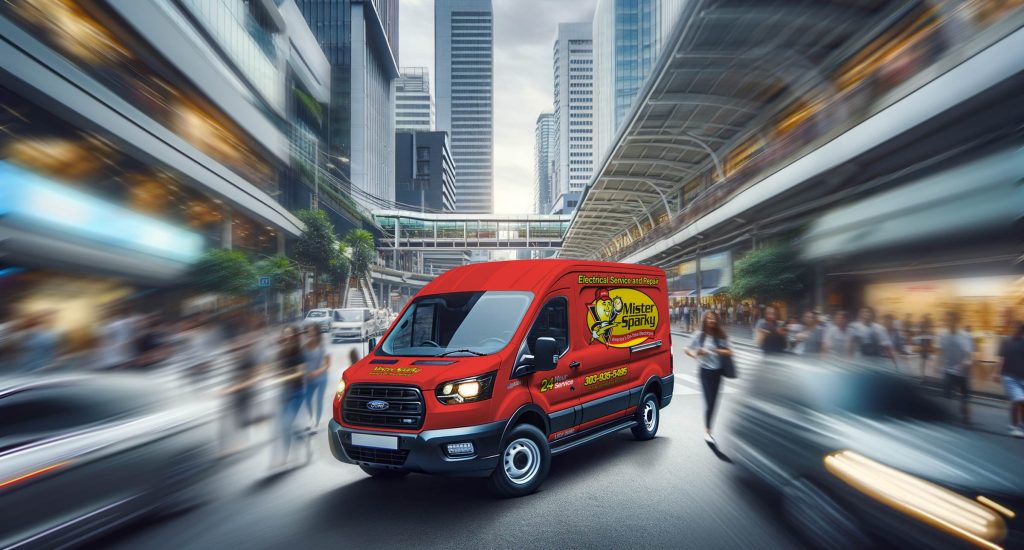
For example, a website or phone number may look clean in a concept image, but on the real vehicle, that text could fall across the gap between a pickup cab and bed. A logo may appear centered on an RV mockup, but if it crosses a slide-out section, the logo could break apart when that section is extended. AI-generated layouts may also overlook windows, handles, hinges, body lines, placards, or areas where graphics cannot be installed safely or effectively.

Carrie pointed to this as one of the biggest differences between AI-generated visuals and human-developed fleet concepts.

“AI can develop a concept based on what the user tells them, but not think much further than that about an audience, demographic, longevity, overall feel of a design the way a human can,” she said.

She also noted that “AI has no thought for actual production methods,” including details like door handles, hinges, and driver visibility.

Kenzie echoed that point from a hands-on design perspective.

“AI consistently fails at understanding the compositions of vehicles,” Kenzie said. “It can not determine whether or not the design will be going over body lines or windows or placards or the flow between the side and rear.”

That is one of the biggest gaps between an AI-generated vehicle image and a fleet graphics layout. AI may create a compelling image, but human designers know how to adapt it so it can be produced, installed, and seen clearly on the road.

AI can create eye-catching images, but fleet branding has to do more than grab attention. It has to communicate clearly and consistently.

A branded vehicle may only have a few seconds to make an impression. Drivers, pedestrians, and customers need to be able to understand who the company is, what it does, and how to recognize the brand quickly.

That requires design restraint, hierarchy, and strategy. A successful fleet design needs to consider the audience, the viewing distance, the speed of traffic, the vehicle shape, brand standards, color contrast, logo placement, message clarity, and long-term consistency across the entire fleet.

Kenzie compares vehicle graphics to moving billboards.

“Vehicle graphics are moving billboards that require the same level of skill, but taking that message to a much larger audience.”
Kenzie Calvin

That perspective is important. Fleet graphics are highly visible brand assets. If a design is too busy, too abstract, or overloaded with visual effects, the viewer may remember that they saw something interesting, but miss the brand message entirely.

Kenzie has seen this happen with AI-generated concepts that try to include too much.

“From the AI I have seen most are incredibly busy and have too much information/visual stimulation to convey a message in the amount of time needed,” she said.

For fleet graphics, that moment of recognition matters. A strong design should be memorable, but it should also be clear. The viewer should be able to understand the brand quickly, whether the vehicle is parked, passing in traffic, or seen from a distance.

That is where human input makes a difference. A trained designer is not only making something attractive. They are making decisions that support the brand, the audience, and the way the vehicle will actually be seen.

What AI often misses in fleet graphics planning

AI-generated concepts can be visually interesting, but they often miss important details that affect production and performance.

Common issues include:

  • Text that is too small, distorted, or unreadable
  • Placeholder words, incorrect spelling, or unrealistic phone numbers
  • Logos that are too small or overwhelmed by supporting graphics
  • Designs that ignore body lines, windows, handles, hinges, and seams
  • Artwork that does not flow correctly from the side to the rear of the vehicle
  • Concepts built on vehicles that do not match the actual fleet
  • Visuals that are too busy to communicate clearly in motion
  • Low-resolution or flattened images that cannot be scaled for production
  • Lack of consistency across multiple vehicle types

Kenzie says some of the visual red flags are noticeable once you know what to look for.

“One of the major red flags I can immediately point out is the smoothness of the design even when it tries to emulate texture, it lacks depth,” she said. She also notes that AI-generated layouts can feel visually inconsistent or physically unrealistic, with “floating objects, inconsistent colors and textures” or elements that do not connect naturally.

Carrie explained that AI also tends to focus only on the specific prompt it is given, rather than the larger fleet program.

“AI doesn’t typically account for how a branding message will look across an entire fleet of vehicles for a company,” she said. “It only considers the one vehicle you ask it to design.”

That distinction matters for companies managing more than one vehicle. A fleet design may need to adapt across vans, box trucks, pickups, trailers, service vehicles, or specialty units while still maintaining a consistent brand presence.

What happens when you bring an AI concept to Signature

When a customer brings an AI-generated concept to Signature Graphics, our team does not treat it as a problem. We treat it as part of the discovery process.

The concept helps us understand the direction you are considering. It can show the general style, tone, colors, energy, or visual approach your team is interested in. From there, our designers and program teams can evaluate what will work, what needs to be adjusted, and what must be rebuilt to support production.

“An AI concept is great for the beginning steps of what a client might be thinking,” Carrie said. “It can tell us a bit about their style; like if they want flashy and modern, or conservative, or have a retro vibe.”

That early direction is useful, but turning it into a finished fleet graphics layout requires additional steps.

That process may include:

  • Reviewing the AI concept for overall direction
  • Identifying which elements are usable as inspiration
  • Comparing the concept to brand standards
  • Confirming the correct vehicle types and specifications
  • Rebuilding or recreating artwork as needed
  • Adjusting layouts around real vehicle features
  • Improving readability, hierarchy, and brand clarity
  • Preparing production-ready files
  • Planning for materials, printing, installation, and rollout needs

Kenzie explains that challenges can happen when an AI-generated concept is treated as an exact final design, especially if it includes effects, artwork, or vehicle details that are not practical to reproduce exactly.

That is why flexibility is important. The goal is not always to copy the AI concept exactly. The goal is to understand the intent behind it and turn that intent into a real-world fleet graphics solution that protects the quality, consistency, and effectiveness of the finished graphics.

How to use AI effectively before starting a fleet graphics project

If your team wants to use AI during the early stages of fleet planning, the best approach is to use it as a communication tool.

Use AI to explore general ideas, not to create final artwork.

Before meeting with a fleet graphics partner, AI can help your team identify:

  • Preferred design styles
  • Colors or moods that feel aligned with the brand
  • Examples of what feels too busy or too plain
  • General likes and dislikes
  • Possible directions for internal discussion
  • Visual themes worth exploring further

When sharing AI concepts with Signature, it is helpful to explain what you like about them. Is it the color? The energy? The layout? The use of photography? The boldness? The simplicity? The more specific your feedback is, the easier it is for our design team to understand the vision and move it forward.

Kenzie’s advice is simple: use the idea as a starting point, then make it your own.

“Take the generic idea and make it your own,” she said.

That is where the strongest creative work happens. AI can help generate a direction, but human designers help shape that direction into something intentional, ownable, and aligned with the brand.

It is also important to stay flexible. An AI-generated image may create a strong first impression, but the final fleet graphics need to be built around your brand standards, your vehicles, your production needs, and your long-term goals.

AI images should support human design, not replace it

AI may continue to improve, and it will likely remain part of the creative conversation. But human expertise should never be removed from the process.

A human designer brings judgment, context, experience, and problem-solving that AI cannot fully replace. Designers use previous project applications and results to improve and learn, they think about the customer, the brand, the message, the vehicle, the production method, the installation process, and the way the finished graphics will perform in the real world.

From a branding perspective, Carrie said human thought remains essential.

“From a sheer branding perspective, I will always argue that human thought is more effective, whereas an AI concept is faster,” she said.

Kenzie’s perspective comes from a similar place: strong creative work should preserve the character of the brand. Fleet graphics should not simply look interesting. They should feel intentional, recognizable, and connected to the company they represent.

AI can create patterns, imagery, and layouts quickly, but branding is more than generating a visual. It involves identity, emotion, clarity, trust, and audience connection. Those are human decisions.

Carrie described the evolution of technology as something that both helps and challenges the creative process.

“Technology seems to make the job easier on one hand, while complicating the request from the client because capabilities have improved, thus increasing a client’s ‘want’ and ‘ask,’” she said.

That balance is important. New tools can help expand ideas, but experienced designers are still needed to turn those ideas into something practical, effective, and brand-right.

The best results happen when AI is used as a tool, not a shortcut.

From concept to fleet-ready graphics

AI can help start the conversation. Signature Graphics helps move it forward.

If your team has used AI to explore fleet graphics ideas, that concept can be a helpful first step. It can give us insight into your vision and help our team understand the direction you want to explore.

From there, Signature brings the design, production, installation, and program experience needed to turn an early concept into graphics that are ready for the road.

Because in fleet branding, the goal is not just to create an interesting image. The goal is to create graphics that represent your brand clearly, consistently, and professionally across every vehicle in your fleet.

Posted in News, UncategorizedTagged , , , , , , , , , , , ,

Don’t Wait Until January: Why Fleet Rollout Planning Belongs in Q4

For many companies, Q4 is a time to wrap up the year, finalize budgets, and prepare for what is next. But for brands managing fleet graphics, Q4 is more than a closing chapter. It is one of the most important planning windows for the year ahead.

Whether your company is preparing for a brand refresh, adding new vehicles, updating franchise graphics, or planning a national rollout, waiting until January to start the conversation can create unnecessary pressure. Fleet graphics programs involve more than artwork and installation. They require planning, coordination, production, logistics, and clear communication across teams. Starting in Q4 gives your brand the time and space to build a smarter rollout plan before the new year is already in motion.

Once January arrives, schedules tend to move quickly. New budgets are active, new goals are in place, and teams are ready to execute. But if a fleet graphics rollout has not already been scoped, those first few weeks can easily become reactive.

Planning in Q4 gives your team time to review what is needed before timelines become urgent. This may include confirming vehicle counts, identifying vehicle types, reviewing existing graphics, gathering brand requirements, and aligning internal stakeholders before production begins.

That early planning helps create a clearer path forward. Instead of starting the year with unanswered questions, your team can enter January with a defined direction, realistic expectations, and the right partners already involved.

Budget conversations are already happening

Q4 is often when companies are finalizing budgets for the upcoming year. That makes it the right time to include fleet graphics in the conversation.

When graphics are planned early, teams can better understand the scope of the program and build it into the annual budget. This is especially important for companies managing large fleets, multiple locations, or phased rollouts across different markets.

A strong budget conversation starts with the right questions. How many vehicles need graphics? Are new vehicles being added next year? Are any existing graphics outdated, damaged, or inconsistent? Will the rollout happen all at once or in phases? Are there installation, shipping, or reporting needs that should be considered?

Answering these questions in Q4 helps brands avoid surprise costs and make more informed decisions about timing, materials, production, and installation.

Fleet graphics programs are not one-step projects. Before graphics ever reach a vehicle, there are important details that need to be worked through.

Artwork needs to be reviewed and adapted to the correct vehicle specifications. Brand standards need to be followed. Materials need to be selected. Production needs to be scheduled. Graphics need to be shipped to the right locations. Installations need to be coordinated around vehicle availability, market needs, and operational timelines.

For national brands and franchise systems, the process becomes even more layered. There may be multiple vehicle types, regional differences, location-specific needs, and brand approval steps that all need to be managed carefully.

Starting in Q4 gives your graphics partner more time to build a rollout plan that accounts for those details. The result is a smoother process, fewer surprises, and a better experience for the teams responsible for getting branded vehicles on the road.

Before planning what comes next, it helps to understand what is already on the road.

A year-end fleet graphics audit can reveal inconsistencies, outdated designs, damaged graphics, missing branding, or vehicles that no longer reflect current standards. It can also help identify which markets, locations, or vehicle types should be prioritized in the next rollout.

For franchise networks and multi-location brands, this step is especially valuable. A fleet may be spread across regions, managed by different teams, or updated at different times. Without a clear review, it can be difficult to know where the brand is showing up consistently and where gaps exist.

Q4 gives companies a natural opportunity to pause, review, and make a plan before new vehicles, new budgets, and new initiatives begin.

Early planning helps prevent rushed decisions

When fleet graphics are planned too late, teams often have to make fast decisions under pressure. That can lead to missed details, inconsistent layouts, rushed approvals, or production timelines that are harder to manage.

Vehicle graphics are highly visible brand assets. They are seen by customers, employees, communities, and competitors. The design, materials, and installation quality all influence how the brand is perceived.

Planning ahead gives teams time to make thoughtful decisions instead of simply trying to meet a deadline. It allows room for design review, production planning, installation coordination, and internal alignment. Most importantly, it helps protect the consistency and professionalism of the brand.

National fleet programs require coordination

For companies managing large-scale rollouts, planning is not just helpful. It is essential.

A national fleet graphics program may involve corporate marketing teams, operations teams, procurement, franchise owners, account managers, installers, and vehicle providers. Each group plays a role in moving the program forward.

Q4 gives these teams time to align before work begins. It allows for clearer communication around scope, timelines, responsibilities, and expectations. It also gives your graphics partner the opportunity to help identify potential challenges before they become problems. When the planning happens early, the rollout can move with more confidence

The right partner makes the process easier

A fleet graphics rollout is easier to manage when you have a partner who understands the full process, not just one piece of it.

At Signature Graphics, we support brands through planning, design adaptation, production, fulfillment, installation coordination, and program reporting. Our team is built to support large vinyl graphics programs and help brands maintain consistency across vehicles, locations, and markets.

For companies preparing for next year’s fleet needs, Q4 is the ideal time to start the conversation. Early planning gives everyone involved a better understanding of the scope, schedule, and steps required to bring the program to life.

Start the year with a plan already in motion

January may feel like the natural time to start new projects, but for fleet graphics, the smartest planning often begins before the year ends.

By starting in Q4, your team can review the current fleet, align budgets, finalize priorities, and prepare for a smoother rollout in the months ahead. Instead of beginning the year with questions, your brand can begin with a plan.

If your company is preparing for a fleet graphics rollout next year, now is the time to start planning.

Signature Graphics can help you build a program that supports your brand, your timeline, and your fleet.

Posted in NewsTagged , , , , , , ,

The Science Behind Eye-Catching Vehicle Wrap Designs

When it comes to fleet branding, a vehicle wrap is more than just a way to cover a truck or van—it’s a powerful marketing tool with the potential to reach thousands of potential customers every day. But what makes a vehicle wrap truly eye-catching and effective? The answer lies in the science of design, including color psychology, font choices, and strategic layout placement. Understanding these elements ensures that your fleet graphics not only stand out but also communicate your brand message effectively, driving more engagement and increasing your return on investment (ROI).

The Psychology of Colors in Vehicle Wraps

Color is one of the first things people notice when they see a vehicle wrap, and different colors evoke specific emotions and associations. Using the right colors in your fleet graphics can enhance brand recognition and influence consumer perception. Here’s a quick breakdown of what various colors can convey:

  • Red – Excitement, urgency, and energy. Often used by fast-food chains and brands wanting to evoke strong emotions. Red grabs attention quickly and creates a sense of action, making it ideal for promotional messaging.
  • Blue – Trust, reliability, and professionalism. A popular choice for corporate and service-based businesses such as financial institutions, healthcare providers, and technology companies.
  • Yellow – Optimism, attention-grabbing, and warmth. Works well for brands that want to appear friendly and inviting, such as food delivery services and retail businesses.
  • Green – Health, sustainability, and growth. Ideal for eco-friendly brands, landscaping companies, and businesses in the natural products sector.
  • Black – Sophistication, luxury, and power. Used by high-end brands to convey exclusivity and professionalism, often paired with metallic finishes for a premium look.
  • Orange – Creativity, enthusiasm, and affordability. Frequently used by budget-friendly brands and companies in creative industries.
  • Purple – Royalty, wisdom, and imagination. A great choice for brands that want to convey a sense of luxury, spirituality, or innovation.

Choosing the right color scheme for your vehicle wrap should align with your brand identity and the emotions you want to evoke in your audience. Using high-contrast color combinations can improve readability and make key messaging more prominent. For example, white text on a dark background or bold, vibrant colors against neutral tones create a strong visual impact.

Font Choices

A great design can be ruined by the wrong font choice. Typography plays a critical role in ensuring your message is readable from a distance. Here’s what to keep in mind when selecting typography for your vehicle wrap:

  • Size Matters – The most important information (like your company name, tagline, and contact details) should be the most prominent. A good rule of thumb is to ensure text is at least 3 inches tall for readability at a distance of 50 feet.
  • Bold and Clear Fonts – Your audience has only a few seconds to read your message. Choose fonts that are easy to read from a distance, such as sans-serif options like Helvetica, Futura, or Arial.
  • Avoid Overly Decorative Fonts – While script and decorative fonts can add personality, they can also be difficult to read at high speeds. Stick to clean, legible typefaces that enhance clarity.
  • Proper Contrast – Make sure your text stands out against the background color. High contrast improves visibility and legibility, making it easier for people to absorb your message quickly.
  • Additional Advantages: Besides the overt benefits of safety and recognition, reflective wraps really do have other benefits. They add to the longevity of the exterior materials of a vehicle, acting as another armor against all but the most severe scrapes and UV damage. This protection ensures the appearance of the vehicle over time, thus reducing the cost of frequent repainting or repairs. Reflective wraps can also be customized, which makes them versatile for police departments to incorporate the specific branding elements, logos, and information that will help with their visibility and public relations efforts.
  • Operational: There are success stories that have been reported by police agencies across the country from the application of reflective wraps. For example, there are fewer cases of accidents experienced with police cars at night because of an improved visibility factor. Secondly, in the policy approaches to police community relations, reflective wraps enhance police presence and visibility across neighborhoods, guaranteeing security and comfort for every resident.
  • Bold and Clear Fonts – Your audience has only a few seconds to read your message. Choose fonts that are easy to read from a distance, such as sans-serif options like Helvetica, Futura, or Arial.

Strategic Layout Placement

An effective vehicle wrap layout guides the viewer’s eye naturally across the design. Placement plays a crucial role in ensuring your message is absorbed quickly and effectively. Here’s how to achieve that:

  • Hierarchy of Information – Arrange elements in order of importance. Your company logo and main message should be the focal points, while secondary details such as website URLs or social media handles should be smaller but still visible.
  • Consider Vehicle Shape and Curves – Design with the contours of the vehicle in mind to prevent distortions or text wrapping around awkward angles. Avoid placing critical messaging over door seams or wheel wells where visibility may be compromised.
  • Balanced Use of Graphics and White Space – Avoid clutter. A clean design with intentional spacing makes the wrap more visually appealing and easier to read. Overloading a design with too many elements can make it overwhelming and reduce effectiveness.
  • Call to Action (CTA) – Whether it’s a website, phone number, or QR code, your CTA should be easy to spot and accessible. A strong, action-oriented CTA like “Call Now for a Free Quote” or “Visit Our Website to Learn More” can drive engagement and conversions.

The Impact of Vehicle Wraps on Brand Awareness and Marketing

Unlike traditional advertising methods, vehicle wraps offer a unique advantage—they reach a broad audience without ongoing costs. Studies show that a single branded vehicle can generate between 30,000 and 70,000 impressions per day, making fleet graphics one of the most cost-effective forms of outdoor advertising. Here’s why they work:

  • Professionalism and Trust – A branded vehicle instills confidence in potential customers by showcasing a polished and professional image.
  • Non-Intrusive Advertising – Unlike digital ads that can be skipped or ignored, vehicle wraps naturally attract attention as they move through traffic.
  • Long-Lasting Exposure – A well-maintained vehicle wrap can last up to five years, providing continuous brand visibility.
  • Targeted Local Marketing – Since fleet vehicles operate within specific service areas, they serve as mobile billboards targeting potential customers in your local market.

Conclusion

The best vehicle wraps are a blend of art and science. By leveraging color psychology, selecting the right fonts, and strategically placing design elements, your fleet graphics can grab attention and reinforce your brand message effectively. Investing in a well-thought-out vehicle wrap design ensures your brand gets noticed every mile of the way.

At Signature Graphics, we specialize in creating high-impact fleet branding solutions that drive results. Whether you’re looking for a full wrap, partial wrap, or custom graphics, our expert team is ready to help. Contact us today to start transforming your fleet into a powerful marketing asset!

We proudly use 3MTM graphic films and overlaminates.

Posted in NewsTagged , , , , , , , , , ,

Signature Graphics Shines in the 2024 Macy’s Thanksgiving Day Parade

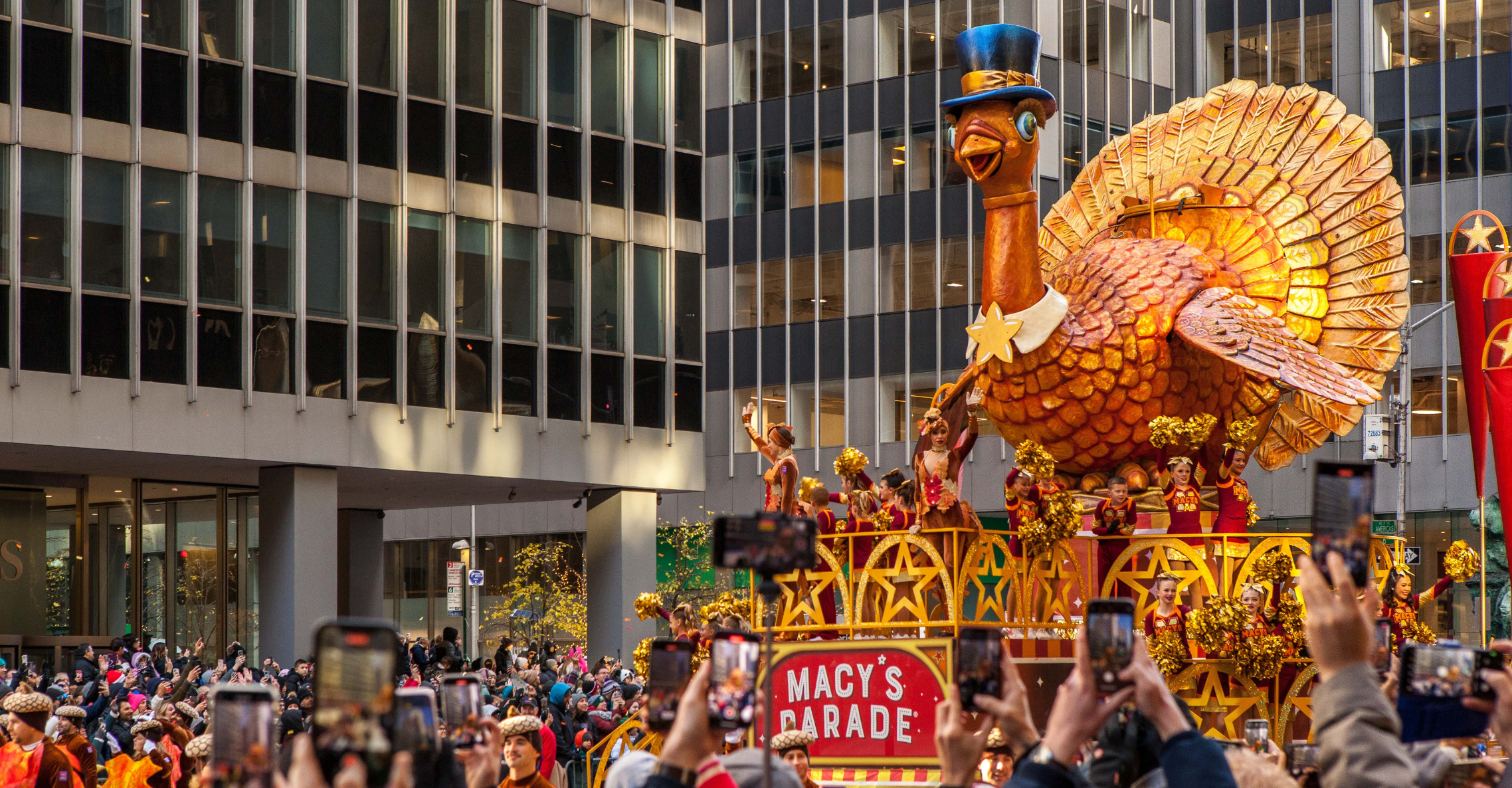
The Macy’s Thanksgiving Day Parade is a beloved holiday tradition, drawing millions of spectators both in person and on television. Known for its larger-than-life balloons, dazzling floats, and incredible performances, this event marks the beginning of the holiday season. This year, Signature Graphics was honored to be part of the magic once again, designing, producing, and installing custom vinyl wraps for three featured trucks: Sesame Street, the Bronx Zoo, and Santa Claus. Each wrap played a pivotal role in bringing the parade’s themes and stories to life.

Behind the Scenes

Creating truck wraps for the Macy’s Thanksgiving Day Parade requires a unique combination of creative expertise, technical precision, and team collaboration. With the parade’s global audience in mind, each design had to be visually stunning, brand-accurate, and cohesive with the overall float theme. Signature Graphics worked meticulously to ensure every detail was flawless, from the initial concept to the final installation.

The stakes were high. Millions of people would see these designs, making it critical to deliver graphics that were both durable and attention-grabbing. Let’s take a closer look at the trucks that stole the show in 2024.

Sesame Street: Spreading Joy Across Generations

Sesame Street, a cornerstone of children’s television, once again delighted audiences with its colorful float featuring Big Bird, Elmo, Cookie Monster, and other beloved characters. Complementing the float, the truck pulling it was transformed into a mobile extension of Sesame Street’s iconic neighborhood.

Design Highlights:

  • A vibrant color palette that mimicked the cheerful and educational tone of the show.
  • Custom illustrations of the show’s characters, ensuring instant recognition for fans young and old.
  • Elements like alphabet blocks and other educational motifs that reflect the show’s mission to make learning fun.

The truck served as a perfect companion to the float, creating a cohesive visual narrative that resonated with audiences worldwide.

Bronx Zoo: Showcasing Wildlife and Conservation

In its first-ever appearance in the Macy’s Thanksgiving Day Parade, the Bronx Zoo celebrated its 125th anniversary with a stunning float showcasing animals like tigers, giraffes, zebras, and gorillas. Signature Graphics designed the truck wrap to emphasize the zoo’s commitment to wildlife conservation and education.

Design Highlights:

  • Intricate patterns inspired by the zoo animals and the skyline of New York City.
  • Greenery and earthy tones to reflect the zoo’s mission of preserving nature.
  • Prominent branding for the Bronx Zoo, ensuring their message reached the millions of viewers tuning in.

The truck not only supported the float but also served as a standalone piece of art, helping the Bronx Zoo connect with a national audience.

Santa Claus: The Grand Finale’s Festive Charm

No Macy’s Thanksgiving Day Parade is complete without the grand finale: Santa Claus. His arrival is a moment of magic, signaling the official start of the holiday season. This year, the truck pulling Santa’s sleigh was adorned with a spectacular wrap designed to elevate the festive spirit.

Design Highlights:

  • Classic holiday imagery, including stars and holiday designs.
  • A rich, wintery color palette featuring deep reds and golds.

The truck added a layer of enchantment to Santa’s entrance, leaving children and adults alike captivated by the holiday magic.

Why Choose Signature Graphics?

This monumental project showcased Signature Graphics’ expertise in creating eye-catching designs for high-profile events. From concept development to installation, our team worked tirelessly to meet the parade’s tight deadlines while maintaining the highest standards of quality.

Our Process:

  1. Collaboration with Clients: Understanding their vision and goals for the design.
  2. Creative Design: Bringing ideas to life with innovative and impactful graphics.
  3. High-Quality Production: Using state-of-the-art materials and techniques to ensure durability.
  4. Expert Installation: Delivering flawless results that stand out, even under the spotlight.

Our ability to handle complex, large-scale projects makes us a trusted partner for organizations looking to make a bold statement.

The Impact of Parade Participation

The Macy’s Thanksgiving Day Parade offers unparalleled exposure, with over 3.5 million attendees and 50 million viewers annually. For brands, having a presence in this iconic event is a chance to reach audiences on a massive scale. By partnering with Signature Graphics, organizations like Sesame Street and the Bronx Zoo were able to amplify their messages with visually compelling designs that made a lasting impression.

About Signature Graphics

At Signature Graphics, we specialize in transforming vehicles and environments with custom vinyl graphics that deliver results. From fleet branding to large-scale event graphics, our services help businesses tell their stories in impactful ways.

Our Core Services:

  • Event and Promotional Graphics
  • Design and Production
  • Vehicle Graphics Installation
  • Fleet Branding Solutions
  • Environmental Graphics

This year’s Macy’s Thanksgiving Day Parade was a testament to the power of creative storytelling through design. We’re proud to have played a role in bringing joy to millions of families across the country. Stay tuned for more exciting projects from the team at Signature Graphics!

We proudly use 3MTM graphic films and overlaminates.

Posted in NewsTagged , , ,

The Safety Feature Every Police Vehicle Needs

Discover how reflective fleet graphics improve the visibility and safety of police vehicles, especially in low-light conditions, ensuring better protection for law enforcement officers and the public.

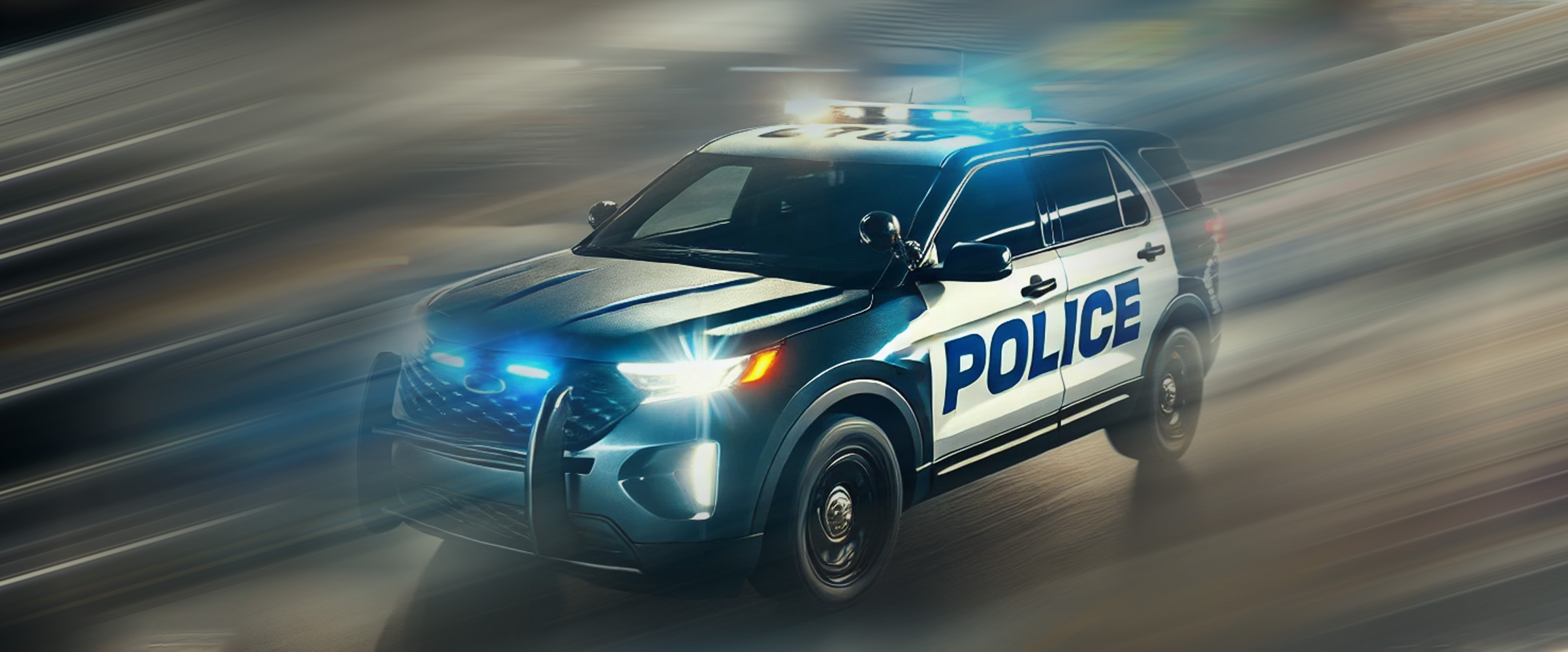
Ever driven down a dark road and spotted a police vehicle just in time to slow down? That split-second recognition is no accident. Reflective fleet graphics play a crucial role in conspicuity of a police vehicle, especially in low-light or at night. These graphics improve the safety of officers and protect the general public by making police vehicles infinitely more visible. Let’s delve into why visibility is so important and how reflective wraps make a difference.

The Importance of Visibility for a Police Vehicle

Visibility is at the core of safety with respect to law enforcement officers. Police vehicles may be used in various environments and conditions where visibility is challenged. The ability for officers to be seen and to see determines their and other individuals’ safety. Let’s take a look at certain specific conditions where visibility plays an important role:

  1. Night Patrols: Darkness greatly reduces the ability to see and be seen. Hazards associated with poor visibility are at their maximum during night patrols. Reflective graphics make police vehicles stand out on the darkest of nights. They will catch light and reflect it from street lamps, vehicle headlights, and other similar sources of light to give a clear impression of the vehicle in view. This increases the visibility of such a vehicle, which prevents accidents because other drivers can see this vehicle in good time and react accordingly. Moreover, it gives a sense of security to the community; they feel that the area is under protection since patrolling does not stop at any given time.
  2. Poor light conditions: These are the hours of dawn and dusk, as well as adverse weather such as rain and fog that limit visibility. When it is at this time of day, combined with elements of the weather, it really turns out to be a nightmare for police work. In this environment, reflective material returns all the available light and shines very brightly, drawing attention to the vehicle. The reflective graphics are helpful in conditions of fog, where visibility may drop very low. It allows visibility of police vehicles to other drivers so the risk of collision can be reduced with a quicker response time. In wet weather, it helps to maintain visibility because the surfaces are reflected, showing that the vehicle can be seen even when the road and all around it are dark and wet.

And Most Importantly:

  1. High-Risk Situations: High-risk situations, in cases of traffic stops or emergency responses, can mean the difference between disaster and bringing the driver to an appropriate speed with caution. Oftentimes, these high-risk situations arise right in the middle of busy roads and highways where fast-flowing traffic could spell danger for both the officer and the community. In such situations, instant recognition of police vehicles is possible because of reflective graphics, giving off a type of signaling that puts drivers on notice to be cautious. Whether a high-speed chase is going on, somebody is calling for roadside assistance or whether there is an upcoming checkpoint, quick identification of police presence eases in handling the traffic flow for the protection of all.

How Reflective Wraps on Your Police Vehicle Improve Safety

Reflective wraps provide a police vehicle with visibility under any condition and thus make it more secure for police officers and the public. This is how they do it:

  1. Light Reflection: Reflective materials are engineered to reflect light back to its source. When headlights or streetlights hit these materials, they shine very brightly and draw all attention to the vehicle. Such a property of reflective wraps is most essential during dark hours of the evening or in areas with dim lighting. The light-reflecting quality ensures that the vehicle is visible from a farther distance. This gives other drivers more than enough time to react responsibly. Through effective reflection of light, these wraps create a glowing effect. This ensures that the vehicle is unmissable, regardless of the lighting in the specific environment.
  2. Enhanced Visibility: High-visibility graphics will ensure that the vehicles are recognizable from far. Quick identification can be a matter of life or death in emergency situations. Immediate recognition of a police vehicle can make all the difference in a high-stress situation, such as a pursuit or a roadside incident, if people and other drivers do not take action. Recognizable graphics help avoid confusion, and in turn, they allow other drivers to act—slow down and yield, among others. In addition, enhanced recognition allows for the fast coordination of the police. So that they can easily find themselves in an operation.

And Another Thing to Consider About Your Police Vehicle

  1. Professional Look: Reflective wraps provide a clean, professional image that maintains the authority and respect commanded by law enforcement vehicles. An effectively designed reflective wrap should do more than just increase visibility; it should maintain the appearance of the vehicle. This professional appearance is crucial in establishing the police force as a presence of authority. It is definitely a sure way that the vehicles will be taken seriously. And commanded respect by the public at large. An across-the-board uniform and professional look throughout the entire fleet helps distinguish the police department. Setting it out as an authoritative brand image that fosters confidence and trust among the community.

Additional Advantages: Besides the overt benefits of safety and recognition, reflective wraps really do have other benefits. They add to the longevity of exterior materials of a vehicle, acting as another armor against all but the most severe scrapes and UV damage. This protection ensures the appearance of the vehicle over time, thus reducing the cost of frequent repainting or repairs. Reflective wraps can also be customized, which makes them versatile for police departments to incorporate the specific branding elements, logos, and information that will help with their visibility and public relations efforts.

Operational: There are success stories that have been reported by police agencies across the country from the application of reflective wraps. For example, there are fewer cases of accidents experienced with police cars at night because of an improved visibility factor. Secondly, in the policy approaches to police community relations, reflective wraps enhance the police presence and visibility across neighborhoods, guaranteeing security and comfort for every resident.

Benefits of Reflective Fleet Graphics on a Police Vehicle

There are many advantages to implementing reflective fleet graphics for law enforcement agencies:

  1. Greater Officer Safety: The primary benefit is that it offers increased officer safety. Reflective wraps ensure that the police vehicles are visible to other motorists, thereby reducing the chances of a crash. Being visible is crucial, especially when there are low lights or at night. As long as a vehicle is seen from afar, the chances of an accident occurring are highly minimized. This increased visibility helps other drivers on the road to quickly identify police vehicles, prompting them to take necessary precautions. Reflective wraps enhance officer safety during traffic stops, roadside assistance, and emergency response by ensuring they can perform their duties safely. They achieve this by preventing collisions.
  2. Public Safety: By making the police vehicle more conspicuous, the public is more likely to respond appropriately. For instance, when the police are on some operations, drivers are likely to slow down and be cautious. Reflective graphics provide a clear identification of a police car, which can influence driver behavior. When drivers notice an illuminated reflective police car, they tend to be more observant. They slow down and become more aware of their surroundings. This behavior protects not only the officers but also other drivers and road users. Additionally, increased visibility can deter potential criminal activities since police officers are more visible on the streets.

Additional Benefits

  1. Durability and Longevity: Reflective wraps are specifically designed to withstand inclement weather conditions. And also aid in preventing daily wear and tear, ensuring long-lasting visibility. High-quality reflective wraps are built to endure various environmental factors like rain, snow, and UV rays. They remain effective and prominent for many years without significant degradation. Their robustness guarantees that they won’t peel, wear off, or fade quickly. This reduces the need for frequent replacements, saving time and resources for law enforcement agencies.
  2. Cost-Effective: While the initial investment may be higher, the long-term benefits of reduced accidents and improved safety make reflective wraps highly cost-effective. Investing in reflective graphics helps law enforcement agencies save money. In the long run, this can prevent vehicle repairs, medical bills, or potential legal costs. The durable nature of the material also means less maintenance costs for frequent replacements. Reflective fleet graphics represent a sound investment due to their enhancement of safety and the potential reduction in liability.
  3. Professional Appearance and Community Trust: Reflective wraps provide a clean, professional appearance. This provides law enforcement vehicles a higher level of authority and respect. A well-maintained fleet with high-visibility graphics not only looks professional but also helps build trust within the community. Citizens are more likely to respect and cooperate with officers when their vehicles present a polished and authoritative image. Moreover, this professional appearance can aid in community policing by fostering a better relationship between law enforcement and the public.

Conclusion

In brief, reflective fleet graphics are important to enhance the visibility of law enforcement vehicles. And, in turn, they help improve safety. These wraps draw attention to the police cars, even in low-light conditions. Therefore safeguarding the officers and, by extension, the public. Using premium quality reflective materials will show commitment to the well-being of the community. And to the officers serving this community. If you are considering replacing or upgrading your police vehicle, consider associating with an expert. They can provide high-quality and effective solutions with care.

FAQs

Reflective fleet graphics are high-visibility wraps and decals designed to reflect light, making police vehicles easily noticeable in low-light conditions.
By improving the visibility of police vehicles, reflective graphics reduce the risk of collisions and ensure that officers are easily recognized during night patrols and in low-light environments.
Yes, while the initial cost may be higher, the long-term benefits of enhanced safety and reduced accidents make reflective wraps a cost-effective investment.
Posted in News, UncategorizedTagged , , , , ,

US DOT Number Requirements

When & Where to Display

Discover the essential requirements for US DOT numbers and where to display them on your commercial vehicles. Ensure compliance and avoid penalties with our comprehensive guide.

Navigating the regulations for commercial vehicles can be tricky, but knowing when and where to display US DOT numbers is crucial for compliance and avoiding penalties. In this article, we’ll explore when you need US DOT numbers and how to display them correctly on your vehicles.

When are US DOT Numbers Required?

Interstate Commerce:

Any commercial vehicle operating in interstate commerce—meaning it travels between states or countries—must have a US DOT number. This includes vehicles transporting goods or passengers across state lines.

Vehicle Specifications:

Commercial vehicles that meet any of the following criteria must display a US DOT number:

  • Vehicles with a gross vehicle weight rating (GVWR) or gross combination weight rating (GCWR) of 10,001 pounds or more.
  • Vehicles designed or used to transport more than 8 passengers (including the driver) for compensation.
  • Vehicles designed or used to transport more than 15 passengers (including the driver) not for compensation.
  • Vehicles used to transport hazardous materials in quantities requiring placards.

Intrastate Commerce:

Some states require US DOT numbers for intrastate commercial vehicles. It’s important to check specific state regulations to determine if your intrastate operations necessitate a US DOT number.

Where to Display Your US DOT Number

Placement on the Vehicle:

You must display the US DOT number on both sides of the commercial vehicle. It should be easily visible and legible from at least 50 feet away during daylight hours while the vehicle is stationary.

Lettering Specifications:

  • Size:The letters and numbers must be at least 2 inches tall.
  • Color:The color of the DOT number should contrast sharply with the background color of the vehicle, ensuring high visibility.
  • Font:The font should be plain and simple, such as Arial or Helvetica, to ensure clarity.

Additional Information:

In addition to the US DOT number, you must also display the legal name or a single trade name of the motor carrier operating the vehicle. Ensure you display this name clearly, making it legible from the required distance.

US DOT ensuring compliance

Ensuring Compliance

Regular Inspections:

Regularly inspect your fleet to ensure that you are displaying US DOT numbers and any other required information correctly and maintaining legibility. Because wear and tear can compromise visibility, it’s critical to conduct periodic checks. These inspections not only help you adhere to regulations but also prevent potential fines and disruptions caused by non-compliance.

Training for Drivers:

Make sure your drivers understand the importance of US DOT numbers and how to display them properly. Conducting regular training sessions can significantly reduce the risk of unintentional non-compliance. This training will equip your drivers with the knowledge they need to meet regulatory standards and operate within legal requirements, ensuring that every vehicle in your fleet represents your commitment to safety and compliance.

Stay Updated on Regulations:

Regulations can change, so it’s important to stay informed about any updates to US DOT number requirements and display rules. Regularly review FMCSA guidelines and state-specific regulations to ensure ongoing compliance.

Conclusion


Understanding when and where to display US DOT numbers is crucial for maintaining compliance with federal and state regulations. Displaying these numbers correctly helps you avoid fines and legal issues, ensuring that your commercial operations run smoothly. By adhering to guidelines for placement and visibility, and staying informed about regulatory changes, you can keep your fleet compliant and operational.

Furthermore, if you encounter any challenges with US DOT number compliance or other regulatory requirements, don’t hesitate to reach out for assistance. We’re here to support you in keeping your fleet running smoothly and legally. This proactive approach not only safeguards your operations but also enhances the efficiency and reliability of your business.

FAQs

A US DOT number is a unique identifier assigned to commercial vehicles operating in interstate commerce or transporting certain types of passengers and goods. It is required to ensure that vehicles comply with safety and regulatory standards set by the Federal Motor Carrier Safety Administration (FMCSA).
Your vehicle needs a US DOT number if it meets any of the following criteria: • It operates in interstate commerce. • It has a gross vehicle weight rating (GVWR) or gross combination weight rating (GCWR) of 10,001 pounds or more. • It is designed or used to transport more than 8 passengers (including the driver) for compensation. • It is designed or used to transport more than 15 passengers (including the driver) not for compensation. • It transports hazardous materials in quantities requiring placards. • Additionally, check state-specific regulations as some states require US DOT numbers for intrastate commercial vehicles.
The US DOT number must be displayed on both sides of the commercial vehicle. It should be easily visible and legible from at least 50 feet away during daylight hours while the vehicle is stationary. The letters and numbers must be at least 2 inches tall, contrast sharply with the vehicle’s background color, and use a plain and simple font like Arial or Helvetica.
In addition to the US DOT number, you may be required to display the legal name or a single trade name of the motor carrier operating the vehicle. This name should be displayed in a similar manner, ensuring it is legible from the required distance.
To ensure ongoing compliance: • Conduct regular inspections of your fleet to ensure that US DOT numbers and any additional required information are correctly displayed and remain legible. • Train your drivers on the importance of US DOT numbers and their proper display to prevent unintentional non-compliance. • Stay informed about updates to US DOT number requirements and display rules by regularly reviewing FMCSA guidelines and state-specific regulations.

We proudly use 3MTM graphic films and overlaminates.

Posted in NewsTagged , , , , , , ,

Fleet Graphics Removal Tips

Best Practices and Tips

Discover the best practices for fleet graphics removal without damaging your vehicle’s surface. Learn the step-by-step process and essential tips for a clean finish.

Removing fleet graphics can be a daunting task, especially if you’re worried about damaging your vehicle’s surface. Whether you’re updating your branding, replacing old graphics, or returning leased vehicles, proper removal is crucial. In this article, we’ll guide you through the best practices and tips for removing fleet graphics, ensuring a clean and professional finish.

1. Gather the Necessary Tools

Before you start, make sure you have all the necessary tools on hand. The right equipment can make the process smoother and prevent potential damage to your vehicle.

Tools You’ll Need:

  • Heat gun or hairdryer
  • Plastic scraper or squeegee
  • Adhesive remover
  • Cleaning cloths
  • Mild soap and water
  • Gloves

2. Assess the Condition of the Graphics

Examine the condition of the graphics before you begin. Older graphics might be more brittle and harder to remove, while newer ones may come off more easily. Understanding the state of the graphics can help you determine the best approach for removal.

3. Heat the Graphics

Heating the graphics is a crucial step that helps loosen the adhesive, making it easier to peel off the vinyl without tearing it.

Steps:

  1. Turn on your heat gun or hairdryer to a medium setting.
  2. Hold the heat source about 6-12 inches away from the graphic.
  3. Move the heat source in a back-and-forth motion to evenly distribute the heat.
  4. Heat a small section of the graphic for about 30-60 seconds.

4. Peel Off the Graphics

Once the adhesive is warm and pliable, you can start peeling off the graphics.

Steps:

  1. Begin at one corner of the graphic.
  2. Use a plastic scraper or your fingers to lift the edge.
  3. Slowly peel back the vinyl at a 45-degree angle. Pulling too quickly or at a sharp angle can cause the vinyl to tear.
  4. Continue heating and peeling in small sections to ensure the adhesive stays pliable.

5. Remove Residual Adhesive

After removing the graphics, you’ll likely find some adhesive residue left on the vehicle’s surface. Removing this residue is essential for a clean finish.

Steps:

  1. Apply adhesive remover to a clean cloth.
  2. Gently rub the cloth over the adhesive residue.
  3. Allow the adhesive remover to sit for a few minutes, softening the residue.
  4. Use a plastic scraper to carefully lift the softened adhesive.
  5. Repeat the process until all residue is removed.

6. Clean the Surface

Once all the graphics and adhesive residue are removed, it’s time to clean the surface thoroughly.

Steps:

  1. Mix mild soap with water to create a cleaning solution.
  2. Use a clean cloth to wash the area, removing any remaining adhesive remover and dirt.
  3. Rinse with clean water and dry with a soft cloth.

7. Inspect for Damage

After cleaning, inspect the vehicle’s surface for any signs of damage. While following the proper removal techniques should prevent most issues, it’s important to check for any scratches or discoloration.

8. Professional Removal Services

While DIY removal is possible, sometimes professional help is the best option, especially for large fleets or stubborn graphics. Professionals have specialized tools and experience to ensure a flawless finish without risking damage to your vehicles.

Conclusion

Fleet graphics removal can be a daunting and delicate task, particularly if you’re concerned about damaging your vehicle’s surface. The process involves more than just peeling off vinyl; it requires careful handling to avoid paint damage, scratches, or adhesive residue that can mar the vehicle’s appearance. Whether you’re updating your branding, replacing outdated graphics, or preparing to return leased vehicles, proper removal is essential to maintain your vehicle’s pristine condition.

While it might seem like a task you can handle yourself, the reality is that DIY removal can often lead to costly mistakes. Professional removal services ensure that the job is done efficiently and safely, using specialized tools and techniques that protect your vehicle’s finish. Our experts are trained to assess the condition of the graphics and the underlying surface, apply the correct amount of heat, and use the right tools to gently lift the vinyl without causing damage.

By leaving the removal to professionals, you can avoid the risk of tearing the vinyl, leaving behind stubborn adhesive residue, or even causing paint damage that requires expensive repairs. Professionals not only guarantee a clean and professional finish but also save you time and hassle, allowing you to focus on more critical aspects of your business.

In summary, while the article provides an overview of best practices and tips for removing fleet graphics, the safest and most efficient route is to trust the professionals. Contact us today for expert fleet graphics removal and ensure your vehicles remain in top condition.

FAQs

To remove fleet graphics without damaging your vehicle’s surface, you’ll need a heat gun or hairdryer, a plastic scraper or squeegee, adhesive remover, cleaning cloths, mild soap and water, and gloves. These tools help ensure a smooth and damage-free removal process.
Using a heat gun or hairdryer on a medium setting, hold the heat source about 6-12 inches away from the graphic. Move the heat source in a back-and-forth motion to evenly distribute the heat, and heat a small section of the graphic for about 30-60 seconds. This helps to loosen the adhesive and makes peeling off the vinyl easier.
After peeling off the graphics, apply adhesive remover to a clean cloth and gently rub it over the adhesive residue. Allow the remover to sit for a few minutes to soften the residue, then use a plastic scraper to lift the softened adhesive. Repeat as necessary until all residue is removed.
Once all graphics and adhesive residue are removed, mix mild soap with water to clean the surface thoroughly. After washing and drying the area, inspect the vehicle’s surface for any signs of damage, such as scratches or discoloration. Proper removal techniques should minimize damage, but it’s important to check carefully.
Consider professional removal services if you have a large fleet, stubborn graphics, or if you’re concerned about potential damage. Professionals use specialized tools and techniques to ensure a flawless finish without risking damage to your vehicles. This option is often more efficient and safer, especially for complex or extensive removal tasks.

We proudly use 3MTM graphic films and overlaminates.

Posted in NewsTagged , , , , ,

Vehicle Graphics ROI

A Step-by-Step Guide to Calculating

Calculating the return on investment (ROI) for vehicle graphics can be a powerful tool for understanding the effectiveness of your branding efforts.

This comprehensive guide will walk you through each step, from identifying your goals to adjusting your strategy based on the results.

1. Identify Vehicle Graphics Goals

Before diving into the numbers, it’s essential to establish clear goals for your vehicle graphics campaign. Are you aiming to increase brand awareness, generate leads, or drive sales? Defining your objectives will help guide your calculations and ensure you measure the right metrics.

Example Goals:

  • Increase brand visibility
  • Drive traffic to a website or physical location
  • Generate leads through calls or inquiries
  • Boost sales for a specific product or service

2. Determine Costs

Next, calculate the total costs associated with your vehicle graphics. This includes the design, production, and installation of the graphics, as well as any maintenance and removal costs.

Cost Components:

  • Design costs
  • Production costs (materials and printing)
  • Installation costs
  • Maintenance and touch-up costs
  • Removal costs (if applicable)

3. Estimate Potential Impressions

Estimating the potential impressions your vehicle graphics will generate involves considering the vehicle’s exposure to potential customers. Factors such as the geographic area, traffic density, and the duration of the campaign play a crucial role.

Factors to Consider:

  • Average daily traffic (ADT) in the areas where the vehicle will be driven
  • Number of days the vehicle will be on the road
  • Visibility and design appeal of the graphics

Formula:

Total Impressions = ADT x Days on Road x Visibility Factor

4. Calculate Conversion Rate

The conversion rate measures how many of those impressions lead to a desired action, such as a website visit, inquiry, or sale. This step involves tracking and analyzing data to understand the effectiveness of your graphics in prompting customer action.

Methods to Track Conversions:

  • Unique URLs or QR codes on the graphics
  • Dedicated phone numbers for inquiries
  • Surveys asking customers how they heard about you

Formula:

Conversion Rate = (Number of Conversions / Total Impressions) × 100

5. Calculate Revenue Generated

Determine the revenue generated from the conversions. This involves multiplying the number of conversions by the average value per conversion. Depending on your goal, this could be the average sale amount or the value of a lead.

Formula:

Revenue Generated = Number of Conversions × Average Value per Conversion

To calculate the average value per conversion, first sum the total revenue generated from all conversions during your campaign. Then, count the total number of conversions. Finally, divide the total revenue by the number of conversions using the formula: Average Value per Conversion = Total Revenue from Conversions / Total Number of Conversions. This metric helps quantify the financial impact of each conversion, providing valuable insights into the effectiveness of your campaign.

6. Subtract Costs from Revenue

To understand the financial impact, subtract the total costs of the vehicle graphics from the revenue generated. This gives you the net profit attributable to the campaign.

Formula:

Net Profit = Revenue Generated – Total Costs

7. Determine ROI

Calculate the ROI to assess the profitability of your vehicle graphics investment. ROI is expressed as a percentage and shows how much return you received relative to your investment.

Formula:

ROI(%) = (Net Profit / Total Costs) x 100

8. Evaluate the Success of the Campaign

Analyzing the ROI and other performance metrics helps you evaluate the success of your vehicle graphics campaign. High ROI indicates a successful campaign, while a low or negative ROI suggests areas for improvement.

Key Metrics to Evaluate:

  • Total impressions
  • Conversion rate
  • Revenue generated
  • ROI percentage

9. Adjust and Optimize Strategy

Based on your evaluation, adjust and optimize your strategy for future campaigns. Consider factors such as design improvements, better-targeted routes, or more effective call-to-action elements on your graphics.

Optimization Tips:

  • Refine graphic design for greater impact
  • Choose high-traffic routes and strategic parking locations
  • Enhance tracking methods for more accurate data
  • Experiment with different calls to action and offers

Conclusion

Calculating the ROI of your vehicle graphics is a multi-step process that involves identifying goals, estimating impressions, tracking conversions, and analyzing financial returns. By following these steps and using precise data, you can effectively measure the impact of your campaign and make informed decisions to enhance future efforts. At Signature Graphics, an Omnicom Group agency, we have the expertise and tools to help you maximize your vehicle graphics ROI, ensuring your branding efforts drive measurable success. Contact us today to learn more about our comprehensive services and how we can assist with your next campaign.

FAQs

Key goals for a vehicle graphics campaign can include increasing brand visibility, driving traffic to a website or physical location, generating leads through calls or inquiries, and boosting sales for specific products or services. Clearly defining these objectives helps guide your calculations and ensures you measure the right metrics.
Estimating potential impressions involves considering factors such as the average daily traffic (ADT) in the areas where the vehicle will be driven, the number of days the vehicle will be on the road, and the visibility and design appeal of the graphics. The formula for calculating total impressions is: Total Impressions = ADT x Days on Road x Visibility Factor.
Tracking conversions can be done through several methods, including using unique URLs or QR codes on the graphics, dedicated phone numbers for inquiries, and surveys asking customers how they heard about you. These methods help you gather data on customer interactions prompted by your vehicle graphics.
To calculate the ROI, first determine the net profit by subtracting the total costs of the vehicle graphics from the revenue generated. Then, use the formula: ROI (%) = (Net Profit / Total Costs) x 100. This percentage shows how much return you received relative to your investment.
After evaluating your campaign’s success using key metrics like total impressions, conversion rate, revenue generated, and ROI percentage, adjust your strategy for future campaigns. Consider refining your graphic design for greater impact, choosing high-traffic routes, enhancing tracking methods for more accurate data, and experimenting with different calls to action and offers. These adjustments can help improve the effectiveness of your vehicle graphics and maximize ROI.

We proudly use 3MTM graphic films and overlaminates.

Posted in NewsTagged , , , , ,

Fleet Graphics ROI Maximized: Strategies for Measurable Success

Uncover strategies to maximize your return on investment with fleet graphics. Learn how to measure success, optimize your campaigns, and grow fleet graphics ROI.

Want to see real results from your fleet graphics investment? Fleet graphics are more than just mobile billboards—they’re powerful marketing tools that can drive brand awareness and sales. But how do you ensure you’re getting the most bang for your buck? We’ve got the strategies to help you maximize ROI and measure your success effectively.

1. Strategic Design for Maximum Impact

Design Matters: A compelling design is crucial for capturing attention and leaving a lasting impression. Your fleet graphics should be bold, clear, and reflective of your brand’s identity. This means using vibrant colors and large fonts that can be easily read from a distance. Incorporate your logo and contact information prominently, ensuring they stand out. The design should be visually appealing but also functional, conveying your message quickly and effectively. Remember, your fleet vehicles are moving advertisements, and the design needs to catch the eye within seconds. By investing in professional design services, you can create graphics that not only look great but also align perfectly with your marketing goals and brand image.

Tips:

  • Use vibrant colors and large fonts.
  • Include your logo and contact information prominently.
  • Ensure the design is readable from a distance.

2. Targeted Geographic Deployment

Deploy Wisely: Deploying your vehicles in high-traffic areas where your target audience is most likely to see them can significantly enhance fleet graphics ROI. This means tailoring your routes and parking spots to maximize visibility. For instance, consider busy shopping districts, popular event venues, or areas with high pedestrian traffic. Use GPS tracking to analyze and optimize these routes, ensuring your fleet is seen by as many potential customers as possible. Additionally, rotating vehicles between different locations can help broaden your reach. By strategically placing your vehicles in the right spots, you can increase the chances of your graphics being seen by your target audience, driving brand awareness and engagement.

Tips:

  • Analyze demographic data to identify key areas.
  • Use GPS tracking to optimize routes.
  • Rotate vehicles to cover different locations.

3. Regular Updates and Maintenance

Stay Fresh: Regularly updating and maintaining your fleet graphics is essential to keep them looking sharp and professional. Faded or damaged graphics can negatively impact your brand image, giving the impression of neglect or poor quality. Schedule regular inspections to check for any signs of wear and tear, and address these issues promptly. Consider refreshing your designs periodically to keep up with new trends or seasonal promotions. This not only ensures your graphics stay vibrant and eye-catching but also keeps your marketing message relevant and engaging. A well-maintained fleet with fresh, appealing graphics reflects positively on your brand and can attract more attention on the road.

Tips:

  • Schedule regular inspections and touch-ups.
  • Refresh designs for seasonal campaigns.
  • Remove and replace outdated graphics promptly.

4. Leveraging Data Analytics

Measuring Performance: Using data analytics to track the performance of your fleet graphics can provide valuable insights into what’s working and what’s not. Metrics such as reach, engagement, and conversion rates are essential for understanding the impact of your graphics. Implement tracking mechanisms like QR codes, unique URLs, or phone numbers to gather data on customer interactions. Use software to monitor vehicle locations and impressions, helping you identify high-performing areas and optimize your routes accordingly. Analyzing sales data in correlation with your fleet graphics campaigns can reveal patterns and help refine your strategy. By leveraging data analytics, you can make informed decisions to maximize the effectiveness of your fleet graphics.

Tips:

  • Implement tracking mechanisms like QR codes or unique URLs.
  • Use software to monitor vehicle locations and impressions.
  • Analyze sales data to correlate with campaign periods.

5. Integration with Digital Campaigns

Cross Promotion: Integrating your fleet graphics with your digital marketing efforts can create a cohesive brand message and amplify the effectiveness of both channels. Include social media handles, hashtags, and website URLs on your graphics to encourage online engagement. Promote your fleet campaign through your digital platforms, sharing photos and updates of your vehicles in action. This cross-promotion not only increases the visibility of your fleet graphics but also drives traffic to your online presence. Encourage your audience to interact with your fleet by offering incentives for sharing photos or posts. By creating a seamless connection between your physical and digital marketing efforts, you can enhance brand recognition and engagement.

Tips:

  • Include social media handles and hashtags on your graphics.
  • Promote your fleet campaign online with photos and updates.
  • Encourage customers to share photos of your fleet on social media.

6. Customer Engagement and Feedback

Get Interactive: Engaging with your audience by making your fleet graphics interactive can enhance customer connection and feedback. Incorporate elements such as QR codes, AR experiences, or social media contests that encourage interaction. These interactive features can drive engagement, making your fleet graphics more memorable and impactful. Offer incentives for customers who engage, such as discounts or promotional items, to boost participation. Collecting and analyzing feedback from these interactions can provide valuable insights into customer preferences and behaviors, helping you refine your strategy. By making your fleet graphics interactive, you create opportunities for deeper engagement and a stronger connection with your audience.

Tips:

  • Use call-to-action elements like “Follow Us” or “Visit Our Website.”
  • Offer incentives for taking photos with your vehicles.
  • Collect and analyze feedback to improve future campaigns.

7. Cost-Effective Production Techniques

Optimize Costs: Balancing quality and cost is crucial for optimizing your fleet graphics investment. Choose durable materials like high-quality vinyl that can withstand various weather conditions and heavy use. Working with reputable suppliers ensures you get the best products at competitive prices. While it might be tempting to cut corners to save money, poor quality graphics can fail quickly, leading to additional costs and a negative impact on your brand image. Investing in quality materials and professional installation can save you money in the long run by reducing the need for frequent replacements or repairs. Optimizing costs without compromising on quality ensures your fleet graphics remain effective and attractive.

Tips:

  • Use high-quality, long-lasting vinyl.
  • Work with experienced graphics installers.
  • Get multiple quotes to ensure competitive pricing.

8. Employee Training and Involvement

Team Effort: Ensuring your drivers and employees understand the importance of fleet graphics and are trained to represent your brand effectively is key to maximizing fleet graphics ROI. Your team should be aware of optimal parking and driving routes to enhance visibility. Train them to handle questions or interactions that may arise due to the graphics, ensuring they can provide accurate and positive information about your brand. Involving employees in the design process can also foster a sense of ownership and pride, motivating them to promote the fleet graphics on their own social media. By making your fleet graphics a team effort, you create ambassadors for your brand who can help amplify your marketing efforts.

Tips:

  • Train drivers on optimal parking and driving routes.
  • Involve employees in the design process for better buy-in.
  • Encourage employees to promote the fleet graphics on their own social media.

Conclusion

Maximizing fleet graphics ROI involves strategic planning, regular maintenance, and continuous analysis. By focusing on impactful design, targeted deployment, and data-driven decisions, you can ensure your fleet graphics deliver measurable success. Trust the professionals to help you navigate this process and achieve the best results. Contact us today to get started on transforming your fleet into a powerful marketing tool.

FAQs

A compelling design is crucial for capturing attention and leaving a lasting impression. Bold, clear graphics that reflect your brand’s identity help in creating an impactful visual presence. Using vibrant colors and large fonts ensures your message is easily readable from a distance, making your fleet vehicles effective moving advertisements. Professional design services can align your graphics with your marketing goals, enhancing overall effectiveness and maximizing ROI.
Deploying fleet vehicles in high-traffic areas increases visibility, ensuring that your graphics are seen by a larger audience. Tailoring routes and parking spots to maximize exposure can significantly enhance brand awareness and engagement. Utilizing GPS tracking to optimize these routes and rotating vehicles between locations helps in broadening reach and targeting potential customers more effectively, thereby improving ROI.
Regular maintenance keeps your fleet graphics looking sharp and professional, which positively impacts your brand image. Faded or damaged graphics can give the impression of neglect and poor quality, deterring potential customers. By scheduling inspections, refreshing designs for seasonal campaigns, and promptly addressing any issues, you ensure your graphics remain vibrant and engaging, ultimately attracting more attention and driving better ROI.
Data analytics provide valuable insights into the performance of your fleet graphics campaigns. By tracking metrics such as reach, engagement, and conversion rates, you can understand what’s working and what’s not. Implementing tracking mechanisms like QR codes and unique URLs allows you to gather data on customer interactions. Analyzing this data helps in identifying high-performing areas and optimizing routes, leading to more informed decisions and maximized effectiveness.
Integrating fleet graphics with digital marketing efforts creates a cohesive brand message and amplifies the effectiveness of both channels. Including social media handles, hashtags, and URLs on your graphics encourages online engagement and drives traffic to your digital platforms. Promoting your fleet campaign online with photos and updates increases visibility and customer interaction. This cross-promotion strategy enhances brand recognition, broadens reach, and ultimately improves ROI.

We proudly use 3MTM graphic films and overlaminates.

Posted in NewsTagged , , , , , , ,

Fleet Graphics Installation Fails to Avoid

Avoid costly mistakes with our guide to common fleet graphics installation fails. Learn from others’ errors and ensure a flawless application.

Even the best-laid plans can go awry – as the experts, we have some tips to avoid fleet graphics installation fails. When it comes to fleet graphics installation, the path to perfection is often fraught with unexpected errors and common pitfalls. While the idea of a DIY installation might seem appealing, the reality can be quite different. Here’s why trusting professionals like us can save you time, money, and a whole lot of frustration. Let’s dive into some of the most frequent fleet graphics installation fails and the valuable lessons we’ve learned from them.

1. Poor Surface Preparation

Lesson Learned: Leave the prep work to the pros.

A common mistake in fleet graphics installation is not adequately preparing the vehicle’s surface. When dirt, grease, and residues are left behind, they can prevent the adhesive from bonding properly, leading to unsightly bubbles and peeling that compromise the graphics’ appearance and durability. Our team mitigates this risk by meticulously cleaning and preparing every vehicle. We use specialized cleaning agents to remove all contaminants, ensuring a pristine surface for flawless application. This thorough preparation is crucial for achieving a smooth, long-lasting finish that maintains the integrity and visual appeal of the graphics.

Why Trust Us:

  • We use industry-grade degreasers and surface preparation solutions.
  • Our team ensures the surface is completely dry and contaminant-free.
  • We have the expertise to spot and address any prep issues that could compromise the installation.

2. Incorrect Measurements

Lesson Learned: Precision requires professional tools and expertise.

Misjudging dimensions during fleet graphics installation can result in misaligned graphics, wasted materials, and significant frustration. Ensuring that the graphics fit seamlessly on a vehicle requires a high level of precision. Without accurate measurements, the final result can look unprofessional and require costly corrections. Our professionals, equipped with extensive experience and specialized tools, guarantee that each graphic is measured and applied with exacting precision. By getting it right the first time, we not only save materials and reduce waste but also ensure that the graphics enhance the vehicle’s appearance and maintain brand integrity.

Why Trust Us:

  • We double-check all measurements using advanced tools.
  • Our templates and methods ensure perfect alignment.
  • We have the experience to handle even the most complex designs.

3. Ignoring Temperature and Environmental Conditions

Lesson Learned: Professionals understand the importance of perfect conditions.

Applying graphics in extreme temperatures or in dusty, windy environments can significantly compromise their adhesion and longevity. When graphics are exposed to such unfavorable conditions, the adhesive may not bond properly, leading to peeling, bubbles, and a reduced lifespan. To prevent these issues, we conduct installations in controlled environments where temperature, humidity, and cleanliness are carefully managed. This ensures the best possible conditions for applying fleet graphics, allowing for a perfect bond and a durable finish that withstands the elements and maintains its visual appeal over time.

Why Trust Us:

  • We apply graphics in temperature-controlled environments.
  • We know the ideal conditions for the best adhesive properties.
  • We have the facilities to avoid environmental challenges.
signature certified installation

4. Rushing the Application Process

Lesson Learned: Rushed jobs lead to costly mistakes.

Hurrying through the installation process often results in bubbles, wrinkles, and misaligned graphics, which can significantly detract from the appearance and effectiveness of fleet graphics. Taking the necessary time to complete each step correctly is crucial for achieving a flawless finish. Our professionals are committed to meticulous application, dedicating the required time and attention to ensure that every graphic is applied perfectly. By not rushing the process, we ensure that the graphics are smooth, correctly aligned, and free of imperfections, ultimately enhancing the overall look and durability of the vehicle’s branding.

Why Trust Us:

  • We allocate ample time for each installation.
  • Our methodical approach ensures no steps are skipped.
  • We follow manufacturer instructions to the letter.

5. Using the Wrong Tools

Lesson Learned: The right tools are essential for a quality job.

Using subpar or incorrect tools can significantly compromise the quality of your fleet graphics installation, leading to poor adhesion, visible flaws, and a less professional appearance. Recognizing the importance of precision and quality, we invest in the best tools available to ensure that every graphic is installed perfectly. Our top-of-the-line equipment enables us to achieve clean cuts, smooth applications, and robust adhesion, which are critical for long-lasting and visually appealing graphics. By prioritizing the use of high-quality tools, we can guarantee that our installations meet the highest standards and provide a superior finish that enhances the vehicle’s overall look.

Why Trust Us:

  • We use high-quality squeegees, knives, and rulers.
  • Our heat guns and other tools are industry-standard.
  • We are equipped for any type of installation, simple or complex.

6. Overstretching the Vinyl

Lesson Learned: Vinyl has limits that professionals respect.

Overstretching the vinyl during application can cause it to retract over time, resulting in edges lifting and creating unsightly gaps that compromise the appearance and durability of the graphics. Our professionals understand the limits of the materials and apply them with the precision and care required to avoid these issues. By using the correct techniques and ensuring that the vinyl is stretched only as much as necessary, we prevent future retraction and maintain a seamless, long-lasting finish. This expertise ensures that the graphics adhere perfectly, preserving the vehicle’s aesthetics and providing a robust representation of your brand.

Why Trust Us:

  • We gently stretch vinyl only as needed.
  • We use heat to mold vinyl to complex shapes without overstretching.
  • Our experience ensures the material conforms perfectly without stress.

7. Failing to Post-Heat and Seal Edges

Lesson Learned: Finishing touches make all the difference.

Skipping the post-heating step or failing to properly seal the edges during fleet graphics installation can lead to premature lifting and peeling, significantly reducing the lifespan and visual appeal of the graphics. Post-heating helps to set the adhesive, ensuring a stronger bond, while sealing the edges prevents dirt, moisture, and air from compromising the adhesion. Our team meticulously performs these crucial steps, ensuring that every edge is thoroughly sealed and post-heated to perfection. This attention to detail guarantees a durable, professional finish that maintains its integrity and appearance over time, providing long-lasting value for your fleet branding.

Why Trust Us:

  • We use heat guns to post-heat graphics after application.
  • We firmly seal edges to prevent dirt and moisture infiltration.
  • We follow manufacturer guidelines for post-heating temperatures.

8. Not Accounting for Vehicle Movement and Flexing

Lesson Learned: Vehicles need graphics that move with them.

Vehicles are constantly in motion, subjecting their graphics to continuous flexing and movement. This dynamic environment requires graphics that are both durable and flexible to maintain their appearance and adhesion over time. Our Signature Certified Installers apply graphics to withstand these stresses. By using high-quality materials and advanced application techniques, we ensure that the graphics can endure the rigors of daily use without peeling, cracking, or fading. This durability ensures that your fleet maintains a professional and consistent appearance, effectively representing your brand wherever the vehicles travel.

Why Trust Us:

  • We use flexible, high-quality vinyl designed for vehicles.
  • We pay extra attention to areas that experience more movement.
  • We regularly inspect and adjust our installations to ensure durability.

Conclusion

Avoiding fleet graphics installation fails requires the expertise, attention to detail, and professional-grade tools and techniques that we at Signature Graphics bring to every job. As an Omnicom Group agency, we pride ourselves on delivering exceptional quality and service. Our team of experts understands the intricacies of fleet graphics installation, from precise measurements and proper surface preparation to the careful application and post-installation processes. Leveraging Signature’s extensive experience and state-of-the-art equipment, ensures a flawlessly executed project. Learning from these common mistakes and trusting in our professional approach guarantees a smooth and successful application process, resulting in stunning graphics that stand the test of time and effectively promote your brand on the road.

Don’t risk costly errors with a DIY approach. Trust the professionals to deliver flawless results every time. Contact us today for a consultation and see how we can transform your fleet into a moving masterpiece.

FAQs

Proper surface preparation is essential because dirt, grease, and residues can prevent the adhesive from bonding correctly, leading to bubbles and peeling. Our team uses specialized cleaning agents to ensure the surface is pristine, which helps achieve a smooth, long-lasting finish.
Accurate measurements are vital to prevent misaligned graphics and wasted materials. Our professionals use advanced tools and templates to double-check all dimensions, ensuring perfect alignment and a professional appearance for every installation.
Applying graphics in controlled environments where temperature, humidity, and cleanliness are managed is crucial. Extreme temperatures, dust, and wind can compromise adhesion and longevity. We ensure the best conditions to achieve a perfect bond and durable finish.
Rushing the installation process often results in bubbles, wrinkles, and misaligned graphics. Our professionals take the necessary time to complete each step meticulously, ensuring a flawless finish that enhances the vehicle’s branding and durability.
Using the right tools is critical for a quality installation. We invest in high-quality squeegees, knives, rulers, and heat guns to ensure clean cuts, smooth applications, and robust adhesion. This approach guarantees a superior finish that maintains the vehicle’s overall look.

We proudly use 3MTM graphic films and overlaminates.